Dashcam & Tracker Fitting Macclesfield
Cameras fitted for drivers in Macclesfield, Bollington, Rainow, Sutton and Prestbury, where half the local mileage is town stop-start and the other half is single-track lane. Hardwired, sited properly and set up for roads where there is usually nobody else around to say what happened.
Lanes Where Nobody Saw It Happen
The driving around Macclesfield splits in two. There is the town — Hurdsfield, Broken Cross, the one-way system, a lot of short journeys — and then there is everything east of it, where the A537 climbs towards the Cat and Fiddle and the lanes out through Rainow, Langley, Wildboarclough and Wincle narrow to a single car’s width between drystone walls. The incidents we hear about from that second half are almost never high-speed collisions. They are mirrors clipped where two drivers each thought the other was giving way, a wing scraped against a wall while reversing to a passing place, and vehicles that carried on without stopping because there was nobody there to make them.
That absence of witnesses is exactly why a camera is more useful here than in a town. Nothing else is going to corroborate your account of who reversed and who did not. It also changes what the camera needs to do. A narrow lens aimed down the road will miss a vehicle squeezing past on the nearside, so a wide field of view matters more than extra pixels, and a rear channel is worth having because a surprising proportion of lane damage happens while going backwards. We mount with that in mind and check the actual coverage on screen, including how much of the nearside wall and verge is in frame.
What a camera has to put up with up here
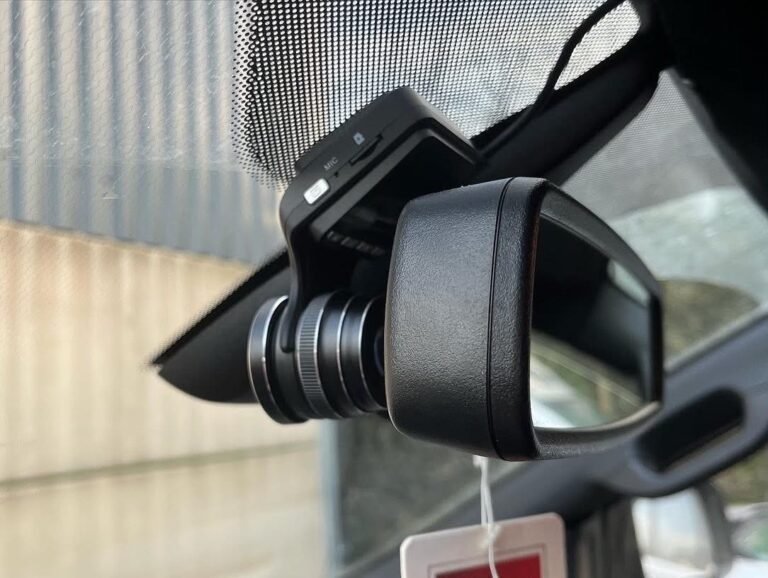
Moorland roads treat equipment badly. Cattle grids, broken edges and frost-damaged surfaces shake a vehicle constantly, and the first thing to give up is usually a suction mount — it creeps, the horizon drifts down over a few weeks, and the footage ends up showing more bonnet than road. We fit adhesive mounts for anything that regularly goes over the tops, and set the angle so a slight settle does not lose the view. Temperature is the other factor: the exposed ground east of town is cold and the inside of a parked windscreen in summer is extremely hot, and that is the condition that kills lithium cells. A supercapacitor camera is the sensible choice for a vehicle that lives up there.
Light is the last piece. The lanes have no street lighting at all, so night footage depends entirely on how the sensor handles a dark frame with one set of oncoming headlights in it. Most cameras will show you clearly that a vehicle was there and far fewer will give you a readable plate, and anyone who tells you otherwise has not watched much night footage. The same goes for low winter sun coming over the moor, which is why we check the camera’s exposure behaviour rather than just its headline resolution. Siting inside the demisted and wiper-swept area of the screen also matters, because a lens behind a patch of morning condensation records a very expensive blur.
Camera And Tracker Work Locally
Done at your house in town or at an address out on the lanes — whichever is easier, as all of the work happens at the vehicle.
Wide-View Front Cameras
Sited and angled so a vehicle easing past on the nearside of a single-track lane is actually inside the frame rather than just outside it.
Rear Channels For Reversing
A second camera for the manoeuvres that cause most rural paint damage, backing towards a passing place or a field gate with a wall either side.
Hardwired, Not Dangling
Fused feeds and cables routed behind trim, so nothing is swinging about on roads rough enough to shake a loose plug out of a socket.
Trackers For Rural Addresses
GPS units hidden on vehicles parked at isolated houses and yards out towards Gawsworth and Pott Shrigley, with no obvious new wiring to find.
Night Driving Advice
Honest guidance on what footage from unlit lanes will and will not show, and on lighting upgrades if the real problem is that you cannot see.
Mounts That Stay Put
Adhesive mounting and a checked horizon for vehicles that cross cattle grids and broken edges every week without the view creeping downwards.
Cameras For Town And Moorland Driving

Camera Fitting Around Macclesfield
We cover the town and the hill villages either side of it, including the addresses along the lanes towards the forest and the Cheshire plain villages to the west.
Questions We Get Asked
Someone clipped my mirror in a passing place and carried on. Would a camera have helped?
It is one of the clearest cases for having one. A forward camera with a wide view will usually show the vehicle, the point at which it came past and often the plate at that distance, which is enough to report it. Without footage those incidents almost always end as nobody’s fault, because there is rarely anybody else on the lane to ask.
Will a dashcam read a number plate on an unlit lane at night?
Sometimes, and we would rather say so honestly than promise it. Oncoming headlights blow out the exposure around the plate, and a plate in your own beam at a sensible distance reads far better than one approaching. Expect reliable identification of the vehicle and its lights, and treat a readable plate at night as a bonus rather than the plan.
Is a suction mount good enough for the roads over the tops?
Not for long. The vibration from grids and broken surfaces works a suction cup loose gradually, so the camera droops and you lose the horizon without noticing. We use adhesive mounts for vehicles that use those roads regularly, and set the angle with a little margin so a small settle does not matter.
Do temperature extremes on the moors affect which camera to choose?
They affect it a great deal. A windscreen-mounted unit bakes in summer and freezes in winter, and lithium cells cope with that poorly over a few years — swollen batteries and dead units are a common end. A supercapacitor model handles the swing much better and is what we would recommend for anything kept at an exposed address.
The inside of my screen mists up first thing. Does that spoil the recording?
It will if the lens sits outside the demisting and wiper area, which is a siting mistake rather than a camera fault. Mounted in the right zone the screen clears in front of the lens as you drive off. Worth remembering that the first mile of a cold morning is also when the lanes are at their worst, so that is footage you want sharp.
Can you fit a tracker to a vehicle kept at an isolated address outside town?
Yes, and those are the addresses where it tends to be most worthwhile, because a vehicle taken from an unoverlooked yard is gone a long time before anybody notices. Siting is chosen to be non-obvious, with a view of the sky and no fresh wiring visible behind any panel somebody is likely to open.
Camera Fitting In Other Areas
Camera For Macclesfield’s Lanes?
Tell us where the vehicle spends its time and we will set the view, the mount and the settings around those roads.