Dark Nights Are Back: Getting Your Lights Right
The clocks go back and overnight the drive home stops being a daylight journey. Most cars are running worse lighting than their owners realise, and it is usually fixable in an afternoon.
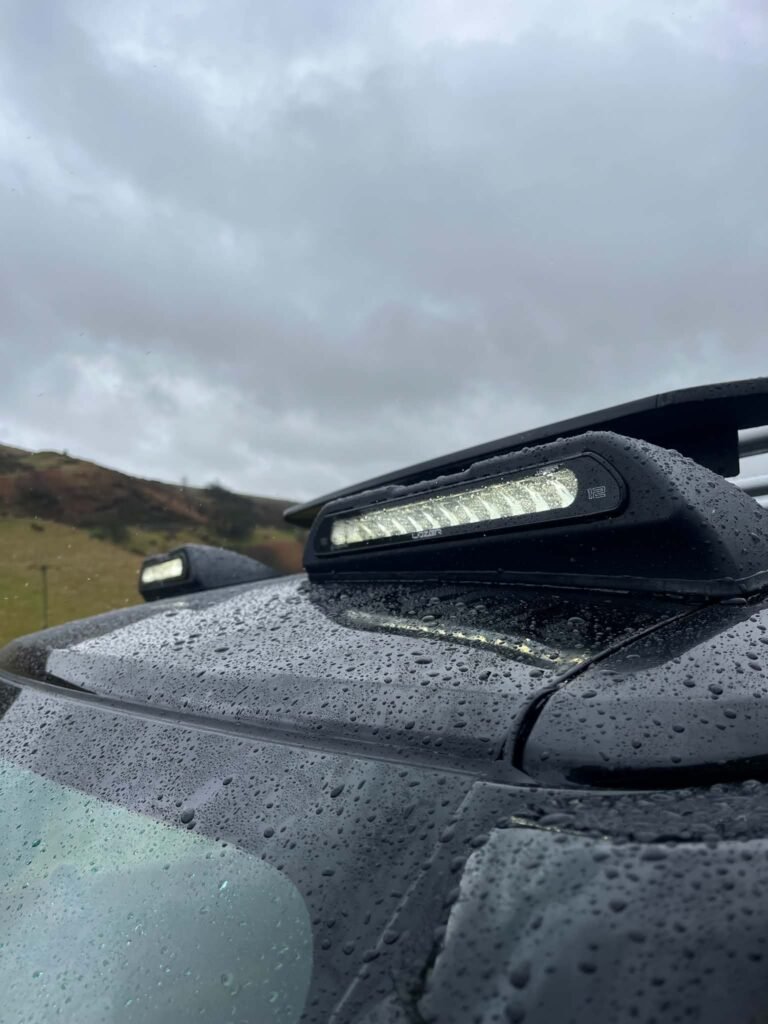
There is a specific week in late October when the phone starts ringing about lights. Nothing has broken — the commute has simply moved from daylight into darkness, and a headlight that was adequate in August is suddenly the only thing between you and an unlit lane with a stone wall on both sides.
Round here that matters more than it does in town. Once you are off the main roads between the Peak villages, the Cheshire lanes or the moorland routes, there is no street lighting at all, the roads are narrow and often wet, and there is livestock behind hedges that occasionally comes through them. Good lighting is not a luxury on those roads, it is the difference between seeing a problem and arriving at it.
Clouded Lenses Cost You More Light Than A Bad Bulb
This is the one people overlook completely. Modern headlight lenses are polycarbonate with a protective coating, and that coating breaks down over years of sunlight, grit and road spray. Once it goes, the plastic underneath oxidises, hazes and yellows.
The effect is not subtle. A badly clouded lens scatters light in every direction instead of putting it where the reflector intended, so you get less light down the road, more glare bouncing back at you in fog, and more dazzle for oncoming drivers. You can fit the brightest bulb on the market behind a yellowed lens and see barely any improvement, because the lens is the bottleneck.
Restoring them properly — cutting the failed coating back and resealing — makes an obvious difference and costs a fraction of new headlamp units. If the haze is on the inside, which happens when a unit has taken in water, that is a different conversation, because a lamp full of moisture will keep eating bulbs until it is sorted.
Beam Alignment: Cheap, Quick, Widely Ignored
A headlight aimed too low throws your light into the road twenty metres ahead and gives you nothing at distance. Aimed too high it dazzles everyone coming the other way and lights up the hedge tops rather than the road. Either way you have paid for light you are not using.
Alignment drifts. It moves when a bulb or unit is changed, after any front-end knock however minor, and as suspension ages and ride height settles. If you tow, or you regularly carry a heavy load in the back, the nose lifts and the beam goes up with it — which is what the manual headlight levelling dial next to the steering wheel is for, and almost nobody touches it.
Worth knowing: if oncoming drivers have started flashing you and you have not changed anything, check the alignment before you assume they are being unreasonable. A beam that has crept upwards is one of the most common causes, and it is a five-minute adjustment once it has been set up against a proper board.
Bulbs: Brighter Is Not The Same As Whiter
The bulb aisle is full of products promising a dramatic upgrade, and a good number of them deliver less usable light than the standard bulb they replace.
The blue-tinted ones are the clearest example. A blue coating on the glass makes the beam look white or bluish, which reads as modern and expensive. It achieves that by filtering out part of the output — so you are throwing away light in exchange for a colour. In dry conditions you might not notice. In rain, fog or falling snow a colder beam scatters more and shows you less, which is exactly when you wanted the light.
What is actually worth paying for:
- Reputable brand-name halogens in a higher-performance version. These genuinely put out more light within the legal rating, at the cost of a shorter life. Fair trade on a car you drive at night a lot.
- Matched pairs, changed together. Bulbs dim as they age, so a new bulb next to a three-year-old one gives you an uneven beam. Change both.
- The correct bulb type for the lamp. Reflector and projector housings are designed around a specific filament position. Put the wrong source in and the beam pattern falls apart no matter how much light it makes.
The last point is why dropping LED bulbs into a housing designed for halogen so often disappoints. The light source sits in a different place and the reflector cannot focus it, so you get glare and a messy cut-off instead of a longer reach. Factory LED and properly engineered conversions are a different matter — the housing is built for the source. If you want LED lighting, it is worth doing as a designed job rather than a bulb swap.
When A Spot Lamp Or Light Bar Genuinely Helps
Auxiliary lighting gets dismissed as a styling accessory, and plenty of it is. But on the right vehicle used on the right roads it is a real, practical improvement.
It earns its place if you regularly drive unlit single-track lanes, if you work off-road or on farm tracks, if you need to see wide rather than just far — spotting a gateway, a gap in a wall, an animal at the verge — or if you need proper work light around the vehicle at night. A pair of well-aimed spot lamps on a vehicle on the tops in February is transformative compared with dipped beam alone.
It does not earn its place if you mostly drive lit A-roads and motorways, where you would rarely be able to use it. Auxiliary lamps are for unlit roads with nobody in front of you, and they come off the moment there is oncoming traffic.
The fitting matters as much as the lamp. Proper relays and fusing, wiring routed and protected so it survives salt and vibration, correct switching so nothing can be left on with the ignition off, and mounting solid enough that the aim does not wander. Badly wired auxiliary lighting is a fire risk and a battery drain. We fit vehicle lighting as a wired-in job for that reason, not a plug-in accessory.
The Legal Side, In Outline
Not a legal guide, and worth checking the current rules yourself, but the broad shape is straightforward. Lighting on the road has to meet type approval requirements, be the right colour in the right position, and must not dazzle other drivers. Auxiliary driving lamps and spot lamps are for use when they will not dazzle anyone — in practice, unlit roads with a clear view ahead — and they should be wired so they cannot be used with dipped beam in a way that causes a nuisance. Light bars in particular have restrictions on how many lamps may be used and how they are wired.
The MOT side is simpler: lights must work, be secure, be the correct colour, and be aimed correctly. A blown bulb or a badly aimed headlamp is a straightforward failure, and lighting faults are among the most common reasons cars fail. That makes a lighting check the cheapest pre-MOT job there is.
A Ten Minute Check Worth Doing Tonight
- Get someone to work the switches while you walk round: sidelights, dipped, main beam, fog lights, indicators, hazards, brake lights, reverse light, number plate lamp
- Look at the lenses in daylight — yellow, hazy or misted inside all need attention
- Park square on to a wall and check the two beams are level with each other and at the same height
- Clean the lenses and, in winter, clear the snow and salt film off them regularly
- Check the rear lamp clusters for water inside, which is what corrodes the bulb holders
While you are at it, this is a sensible time of year to think about a dashcam. Dark, wet roads with poor visibility are exactly the conditions that produce disputed incidents, and having the footage settles an argument before it starts.
Sort Your Lighting Before Mid-Winter
Lens restoration, beam setting, bulb upgrades and properly wired spot lamps — done at your home or workplace.
📞 Call 07803 397561 Message On WhatsApp
Leave a Reply