Alternator Or Battery? Telling Which One Has Failed
These two faults feel almost identical from the driver’s seat, which is why so many people buy a battery they did not need. The symptoms do separate them, if you know what to notice.
The two components do different jobs. The battery stores enough energy to turn the engine over and to run things briefly with the engine off. The alternator makes electricity once the engine is running, powers everything the car needs, and puts back what starting took out.
Because they work as a pair, either failing produces the same headline symptom — a car that will not start. Beyond that headline, they behave quite differently, and the differences are easy enough to spot that you can usually work out which one you are dealing with before anyone opens the bonnet.
What A Failing Battery Looks Like
A battery losing capacity fails on starting, and it fails in the cold and after standing.
- Slow, laboured cranking, especially on the first start of a cold morning. The engine turns but sounds like it is struggling against something.
- It starts fine at lunchtime and refuses at seven in the morning. Cold reduces what a battery can deliver and thickens the oil the engine has to turn.
- Fine after a run, dead after standing for a few days. A weak battery self-discharges faster and has no reserve.
- Dashboard lights dimming noticeably while cranking, then the car running perfectly once started.
- A clicking from the starter with no crank at all, or everything on the dash resetting when you turn the key.
- Stop-start refusing to work. Many cars disable stop-start when the battery is not healthy enough, and it is often the first sign, well before starting becomes a problem.
The key pattern with a battery: once it is running, everything is normal. The car drives properly, nothing dims, no warning lights, no odd behaviour. All the trouble is at the point of starting.
What A Failing Alternator Looks Like
An alternator fails on running, and the symptoms appear while you are driving.
- The battery warning light on with the engine running. This is the headline symptom and it is worth being clear about what it means.
- Lights dimming at idle and brightening when you rev, or headlights pulsing with engine speed.
- Dashboard lights coming on in odd combinations as voltage falls — ABS, traction control, power steering — because modules start complaining about supply voltage rather than about themselves.
- The heater blower slowing down, wipers getting sluggish, the radio cutting out or resetting.
- A whine or growl that rises with engine speed, from worn alternator bearings, or a squeal from a slipping belt.
- A burning smell — hot insulation or a hot belt.
- The car dying while being driven, which a battery fault does not do. If the alternator stops charging, the battery runs the whole car until it is flat, and then everything stops.
How long you get between the light coming on and the car stopping depends entirely on the battery and what is switched on. It might be an hour, it might be ten minutes on a wet night with headlights, wipers and heater going. Treat it as short.
Worth knowing: the battery-shaped warning light means the charging system is not charging. It is not a battery condition light. If it comes on while driving, the most likely causes are the alternator, its belt, or the wiring between it and the battery — replacing the battery will not put it out.
The Jump Start Test
This is the most useful roadside test there is, and it is genuinely decisive.
Jump the car, then disconnect the leads and see what happens next.
If it runs on happily — idles steadily, lights normal, no warning light — the alternator is working and the problem is the battery, or something that drained it, or a bad connection.
If it dies within moments of the leads coming off, or the battery light stays on and the car soon stalls, the alternator is not producing. The car was running on the donor vehicle, not on itself.
That single observation separates the two faults in about thirty seconds, and it is why it is worth phoning before buying parts. Two related patterns are also worth knowing: a car that will not crank at all but has bright, steady dashboard lights is often a starter or a connection rather than a battery; and a car that cranks normally and simply will not fire is not an electrical supply problem at all.
Voltage, In General Terms
You do not need a workshop to take a meaningful voltage reading — a basic multimeter across the battery terminals will do it — and the broad picture is easy to interpret.
With the engine off and the car having stood for a while, a healthy fully charged battery sits a little over 12.6 volts. Around 12.4 is partly discharged. Near 12.0 it is largely flat, and something well below 12 has either been drained hard or has a failed cell.
With the engine running, the alternator should raise the system voltage clearly above the resting figure — typically somewhere in the 13.5 to 14.5 volt range on most vehicles. If the running voltage is barely above the resting voltage, it is not charging. If it is well above that range, the regulator has failed the other way, which is worse, because overcharging cooks a battery and can damage electronics.
Two caveats. Many modern cars use smart charging and deliberately vary the voltage depending on battery state, temperature and load — so a reading that looks low on a car with a battery sensor is not automatically a fault, and these systems need to be interpreted with data from the car rather than a meter alone. And surface charge makes a battery that has just been driven read higher than it really is, so a resting reading means resting, not two minutes after switching off.
Why New Batteries Get Wasted
The common story: car will not start, a battery gets fitted, it is fine for a fortnight, and then it is flat again. Now there are two batteries and the original fault is still there.
The reasons a battery keeps going flat when the battery is not the problem:
- The alternator is not charging properly. Sometimes not at all, sometimes charging weakly enough that short journeys never keep up.
- A parasitic drain. Something drawing current with the car locked — a module not going to sleep, a boot or glovebox light, an aftermarket alarm, a tracker or dashcam wired to a permanent live without a cutoff, a failing relay. These are found by measuring current draw over time, not by guessing.
- Bad connections. A corroded terminal, a loose clamp, or a poor earth strap between engine and body will mimic both faults. It is the first thing worth checking and costs nothing.
- Use pattern. Short journeys in winter, with heated screens and seats, can take more out of a battery than a few miles puts back. Nothing is broken; the car is being used in a way that keeps it undercharged.
- The wrong battery, or one not registered. Many cars with stop-start need an AGM or EFB battery, and many need the new battery coded to the car so the charging strategy suits it. Fit a standard battery, or fit the right one without registering it, and it will be charged incorrectly and die early.
That last point catches a lot of people out on cars from the last decade or so, and it is not optional on the vehicles that require it.
Testing It Properly
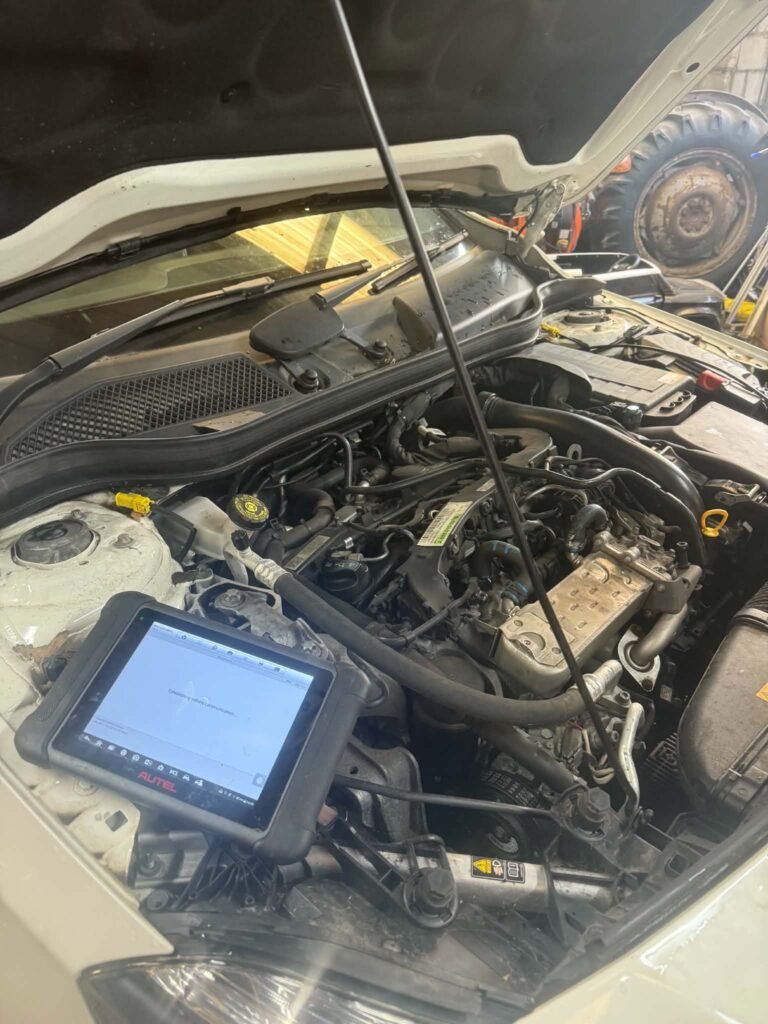
Doing this properly means testing the system, not swapping parts. In practice that is: a load or conductance test on the battery to see what capacity is actually left; a charging test with the engine running and then with a realistic load applied, because some alternators cope at idle and fall over with lights and blower on; a voltage-drop check across the main cables and earths; a parasitic drain measurement if the complaint is going flat while parked; and reading the car’s own data on battery state and charging strategy where it has a sensor.
All of that can be done where the vehicle is standing, which is why it suits a mobile diagnostic and roadside visit — you get an answer before any parts are bought. If the outcome is an alternator, that is usually a job we can do on site too, and if a car needs more than that it gets booked in with us.
The cost of testing first is small. The cost of guessing is a battery you did not need and an alternator you still have to pay for.
Not Sure Which One It Is?
We will test the battery and the charging system on site and tell you what actually needs replacing.
📞 Call 07803 397561 Message On WhatsApp
Leave a Reply