DPF Light On? Short Journeys Are Usually Why
A DPF light is rarely a broken part. It is usually a diesel being used in a way that never lets it clean itself — and how you respond in the first few days decides whether this is a cheap problem or an expensive one.
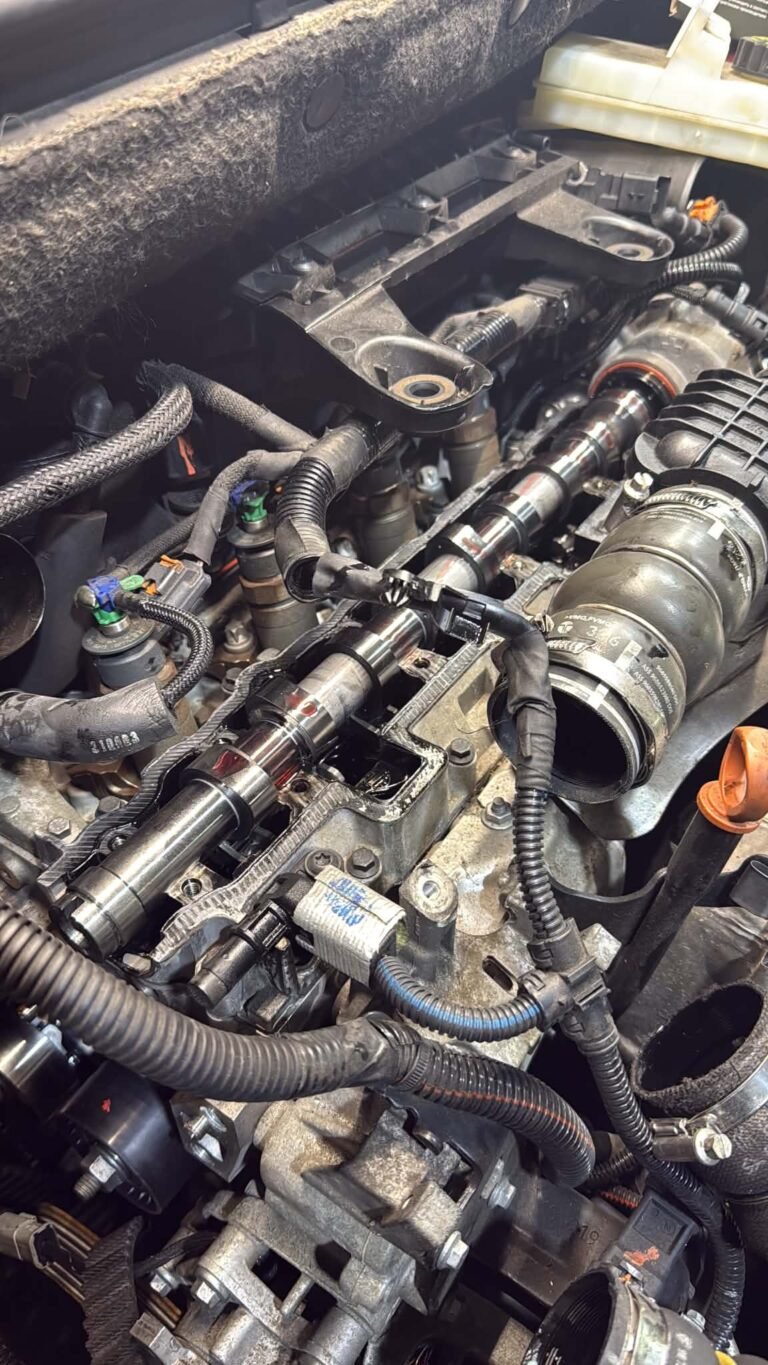
The diesel particulate filter sits in the exhaust and traps the soot a diesel engine produces. That is all it does. It is a ceramic honeycomb with channels blocked at alternate ends, so exhaust gas has to pass through the walls and the soot stays behind. It works extremely well, which is exactly the problem — anything that traps soot eventually fills with soot, and it has to be emptied somehow.
The way it empties is by getting hot enough to burn the soot off into ash and gas. That process is called regeneration, and everything that goes wrong with a DPF comes back to regeneration not happening often enough.
Passive And Active Regeneration
Passive regeneration happens on its own, with no input from the engine management, when the exhaust is running hot for a sustained period. Steady motorway or dual-carriageway driving does it. You never know it has happened, and it is the ideal way for a DPF to stay clean.
Active regeneration is the fallback. When the car works out the filter is filling — usually by measuring the pressure difference across it and by counting the soot it thinks it has produced — it deliberately raises the exhaust temperature. It does this by injecting extra fuel late in the cycle, adjusting timing, and often by closing off the intake slightly. The exhaust gets very hot and the soot burns off.
An active regen needs several things to be true at once: the engine at proper operating temperature, a reasonable amount of fuel in the tank, a steady load, and — crucially — enough time. It is not a two-minute process. If you switch off partway through, the cycle is abandoned and has to start again from the beginning next time.
Why A School-Run Life Never Gets There
Consider a typical week: two miles to school, a mile to the shop, four miles to work, the same back. Every journey is short, the engine may barely reach full temperature before it is switched off, and the exhaust never sees the sustained heat passive regeneration needs.
Worse, the car keeps trying to run active regens and keeps being interrupted. Each abandoned attempt dumps extra fuel into the engine, some of which finds its way past the rings into the sump. That is why cars used like this often show a rising oil level, and why the oil ends up diluted with diesel — which is not doing the engine any favours either.
So the filter fills, the attempts to clear it fail, and eventually the car tells you about it.
What The Light Actually Means, Stage By Stage
DPF warnings are not one message. Roughly, and the exact behaviour varies by manufacturer:
- DPF light on, nothing else. The filter is loaded but within range, and the car is asking for a proper drive so it can complete a regen. This is the cheap stage. Act now.
- DPF light plus reduced power, or the light flashing. The filter is heavily loaded and the car has restricted output to protect itself. A drive may still clear it, but you are closer to the edge.
- Engine management light joins in, limp mode, will not rev past a certain point. The car has given up on self-clearing and has logged faults. This now needs equipment, not a drive.
- Warnings about oil level or oil dilution. Repeated failed regens have put diesel in the sump. This needs an oil and filter change as well as the DPF sorting.
People routinely drive around at stage one for months because the car still goes. That is how a problem that a forty-minute drive would have fixed becomes a filter that has to come off.
The Long Drive Fix, And When It Is Too Late
At stage one, the fix genuinely is a decent drive. What that means in practice: get the engine fully warm first, then find a dual carriageway or a fast A-road and hold a steady speed in a gear that keeps the revs up — somewhere around 2,000 to 2,500rpm is the usual advice — for a good twenty to forty minutes without stopping. Do not sit in traffic, do not do it in top gear at 40mph, and do not switch off as soon as you get home if it feels like something is happening.
You can often tell a regen is running: a hot, slightly acrid smell, the cooling fan running hard when you stop, a change in idle, sometimes a faint whistle. If the light goes out, it worked.
It is too late for the drive-it fix when the car is in limp mode, when the light is flashing and power is well down, or when it has gone through several cycles of clearing and coming straight back. At that point the filter is loaded beyond the level at which the car will risk an active regen, because burning off that much soot at once can crack the ceramic. Sensibly, it refuses.
Worth knowing: soot burns off in a regen, but ash does not. Ash is the leftover from burnt soot and from oil additives, and it accumulates for the life of the filter. That is why a high-mileage DPF can be permanently blocked even though it has been regenerated faithfully — and why a filter that fills again within a few hundred miles of a successful regen is telling you it is full of ash, not soot.
Forced Regeneration
A forced regen is a regeneration commanded through the diagnostic socket rather than initiated by the car. It bypasses the conditions the car would normally insist on and runs the cycle under controlled conditions while the vehicle is stationary, with the engine held at a set speed and the exhaust temperature monitored.
It is a proper job rather than a button press. The soot load has to be read first, because forcing a regen on a filter that is too far gone can damage it. Related faults need checking at the same time — a leaking injector, a faulty differential pressure sensor, a split in the exhaust ahead of the filter, a stuck EGR valve or a glow plug fault will all stop regens working, and clearing the filter without fixing the cause just resets the clock. If the oil is diesel-diluted it should be changed as part of the work.
We can run a forced regeneration and full diagnostic check at your home or workplace, which is usually more convenient than leaving a car somewhere for a day. If the filter turns out to be ash-loaded rather than soot-loaded, no amount of forcing will help and the honest answer is cleaning off the vehicle or replacement — that gets booked in with us rather than done on a driveway.
Why Removal Is Not An Option
Removing or gutting a DPF, or fitting a delete map, comes up constantly because it appears to solve the problem cheaply. It does not, for reasons that have nothing to do with opinion:
- A vehicle first fitted with a DPF cannot pass an MOT with it missing — testers check for it visually, and a removed filter is a failure.
- Driving a vehicle whose emissions control has been defeated puts you on the wrong side of the rules on using a vehicle in a modified condition, and insurers treat an undeclared emissions modification as exactly that.
- Resale becomes somebody else’s problem to discover, which is a poor position to be in.
The specifics of the rules do change, so check the current position rather than relying on what was true a few years ago — but the direction of travel has only ever been one way, towards more scrutiny rather than less.
Is A Diesel Just The Wrong Car For You?
This is worth saying plainly, because it is the actual answer for a lot of people. If your annual mileage is low and almost all of it is short, cold, stop-start journeys, a modern diesel is working against its design every single day. You will keep having DPF problems, you will get diesel in the oil, and you will spend money at intervals on a fault that is really just a mismatch between the car and the use.
If your driving includes regular longer runs — a commute of fifteen miles or more, motorway work, towing, or the sort of mileage that comes with living out in the villages and driving into Stockport or Stoke — a diesel is fine and the DPF will look after itself.
The middle ground is to keep the diesel and change the habit: once a fortnight, take it for a proper run and let it get hot. That is not a fudge, it is genuinely what the filter needs.
DPF Light Not Going Out?
We will read the soot load, check what is stopping regens, and tell you whether a forced regen will fix it.
📞 Call 07803 397561 Message On WhatsApp
Leave a Reply