The Engine Management Light: What It Actually Means
Nobody is pleased to see it, and most people are told either to ignore it or to panic. Neither is right. Here is what the light is telling you, and what it is not.
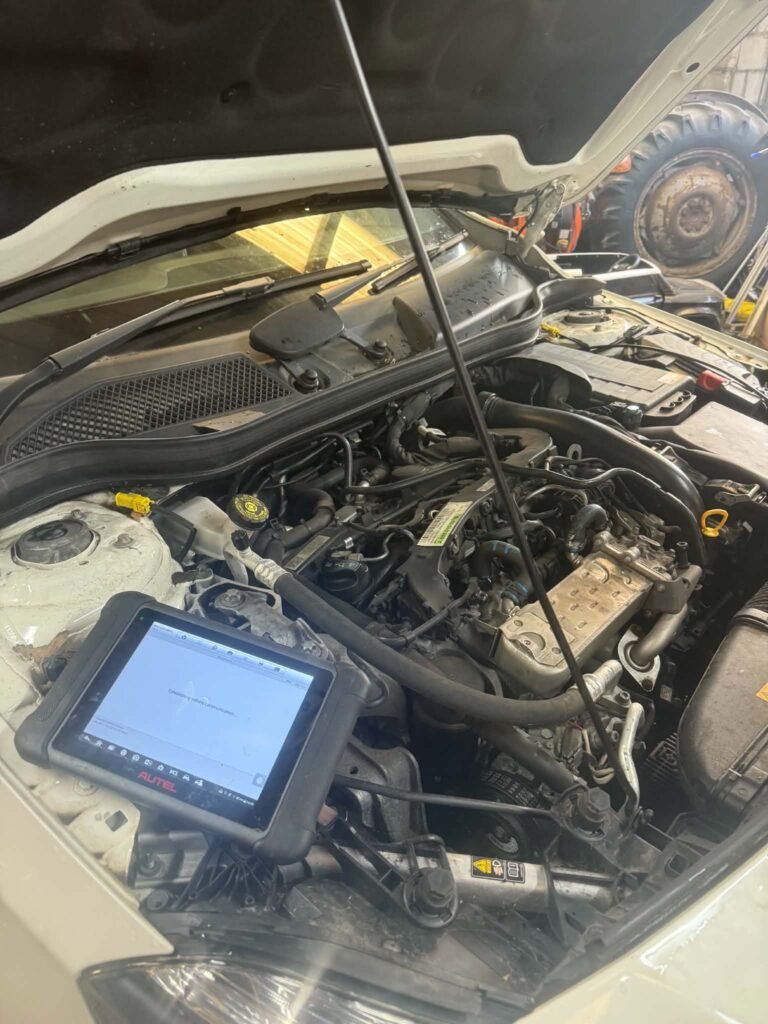
Steady Or Flashing Changes Everything
The first thing to look at is not the code, it is the behaviour of the lamp itself.
A steady light means the engine management system has logged a fault and wants it looked at. The car is usually drivable. Drive it gently, notice whether it feels any different, and get it read sooner rather than later — a small fault left alone tends to turn into a bigger one, and some faults quietly ruin fuel economy for months.
A flashing light is a different message. On most cars that means a misfire serious enough that unburnt fuel is going down the exhaust. That fuel burns in the catalytic converter instead of in the cylinder, and a cat is not built for it — it can be cooked in a matter of miles. A flashing light means stop driving, not “carry on and book it in”.
Worth knowing: if the light starts flashing, ease off, get somewhere safe and switch the engine off. Continuing on a heavy misfire can turn a coil pack or an injector into a coil pack, an injector and a catalytic converter, and the cat is by far the most expensive part of that list.
You may also find the car drops into a reduced-power limp mode. That is the ECU protecting the engine rather than another fault on top — it is deliberately limiting what you can do until the problem is dealt with.
The Light Is A Symptom, Not A Diagnosis
The engine management system spends its whole life watching sensors and comparing what they report against what it expects. When a reading sits outside the expected range for long enough, or a self-test fails, it stores a fault code and lights the lamp.
So the light means exactly this: something is not behaving the way I expect it to. It does not say which component is broken. It does not even promise that a component is broken — plenty of codes are set by a split hose, a chafed wire or a corroded connector while every part named in the code is fine.
A Code Reader Gives You A Code, Not An Answer
Cheap readers and phone dongles are genuinely useful for knowing whether anything is stored and roughly which area it sits in. What they cannot do is tell you the cause, and this is where most money gets wasted.
Take a common one: a code for the mixture running lean on bank one. Read literally, that sounds like an oxygen sensor. In practice the sensor is usually working perfectly and reporting the truth — the engine really is running lean. The cause might be an air leak after the airflow meter, a leaking intake gasket, weak fuel pressure, a dirty airflow sensor, a tired injector, or an exhaust leak upstream of the sensor drawing air in. Replacing the sensor changes nothing except your bank balance.
The pattern is nearly always the same: the code names the observation, and the part mentioned in the code is the messenger. Parts fitted on the strength of a code alone are the reason so many cars arrive with a history of three replaced sensors and the same light still on.
What Proper Diagnosis Looks Like
Reading the codes is step one of about six. The work that actually finds the cause is:
- Freeze frame data — the snapshot of conditions at the moment the fault was stored. Engine speed, load, temperature, road speed. It tells you whether this happens cold, hot, on load or at idle.
- Live data — watching sensors work while the engine runs, and seeing whether their readings make sense against each other rather than just being inside a tolerance band.
- Fuel trims — how far the ECU is having to correct the mixture, and whether that correction changes with engine speed. That single reading separates an air leak from a fuelling problem.
- Actuator tests — commanding a valve, a pump or an injector directly to see whether it responds.
- Physical testing — a smoke test for air leaks, pressure and voltage checks, back-probing connectors, and a scope on a sensor signal where the numbers alone are not enough.
Done that way, the fault gets found once and fixed once. It is unglamorous work and it takes time, but it costs far less than fitting parts in hope. All of it is part of our servicing and repair work and most of it can be done wherever the vehicle is standing.
What Sets It Off Most Often
Across the cars we see, the light is most commonly down to one of these:
- Oxygen or lambda sensors — sometimes genuinely faulty, often reporting a real problem elsewhere
- Airflow sensors, either contaminated or reading out of range
- EGR valves sticking, clogging or being commanded and not moving
- Coil packs, plugs and injectors causing misfires
- Unmetered air getting in through split hoses, perished gaskets or a loose clip
- Thermostats and coolant temperature sensors, which throw the whole fuelling strategy off
- On diesels, DPF regeneration problems, glow plugs and turbo control faults
- Evaporative emissions faults — sometimes as trivial as a fuel cap not sealing
- Wiring and connectors, particularly anywhere exposed to road spray and salt
Why Clearing It Without Fixing It Is Pointless
Clearing the code makes the lamp go out. It does not fix anything, the light comes back as soon as the ECU sees the fault again, and it destroys the freeze frame data that would have helped find the cause. If you clear codes before having the car looked at, you have thrown away the most useful evidence you had.
There is an MOT angle too. The tester checks the warning lights, and an illuminated engine management light counts against the car — it is not something you can talk your way past on the day. Clearing it in the car park is also a poor plan, because on many vehicles the emissions self-tests need a period of driving to complete afterwards, and an incomplete set of monitors is itself a problem. MOT rules are updated from time to time, so check the current requirements if you want the detail, but the practical point stands: the light needs fixing, not hiding, before the test.
It Is Not Always Expensive
Worth saying plainly, because the light causes a lot of unnecessary dread. A good share of engine management faults turn out to be a hose, a connector, a sensor or a cap — cheap parts, modest labour. What makes them expensive is leaving them. A misfire ignored takes the catalytic converter with it, a cooling fault ignored damages far more than a thermostat, and a small air leak ignored slowly wrecks your fuel economy while you pay for it at every fill-up.
Light On? Get It Read Properly
We diagnose engine management faults at your home or workplace, with live data rather than guesswork.
📞 Call 07803 397561 Message On WhatsApp
Leave a Reply