How Often Should A Cambelt Really Be Changed?
The cambelt is the one maintenance item where getting it wrong does not mean a repair bill — it means a new engine. And the mistake people make is almost always about age, not mileage.
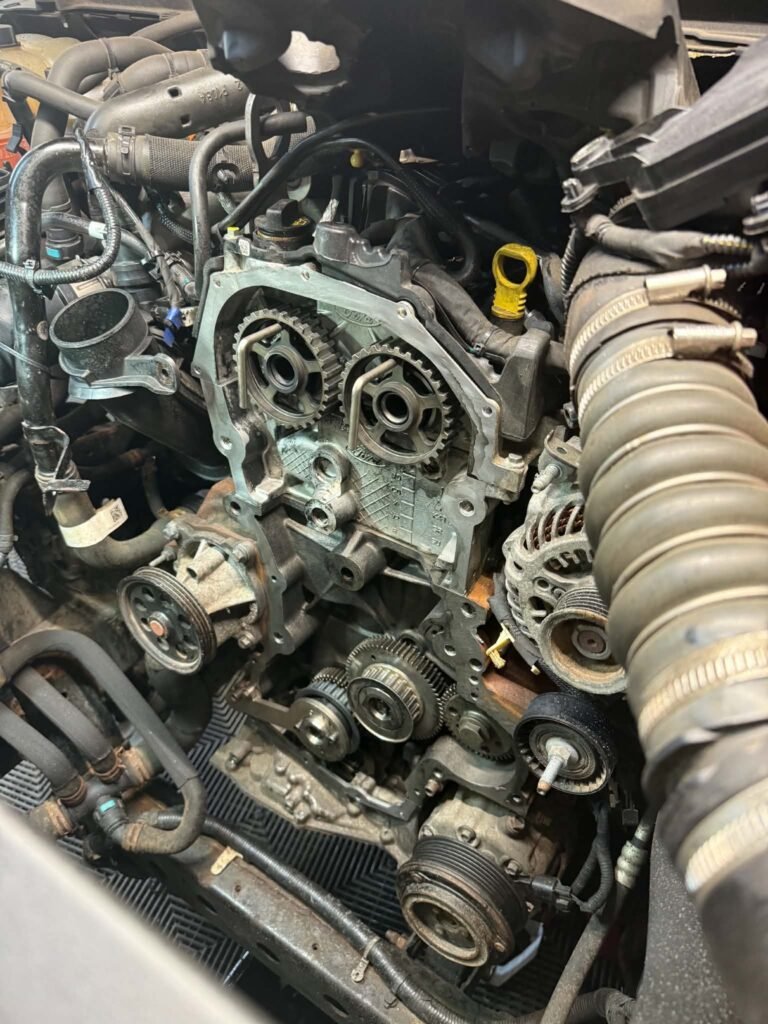
A timing belt keeps the crankshaft and camshaft turning in step, so the valves open and close at exactly the right moment relative to the pistons. It is a toothed rubber belt doing a job that absolutely cannot be interrupted, and it has a defined service life for that reason.
The Interval Has Two Numbers And People Only Remember One
Every manufacturer specifies a cambelt interval as a mileage and a time limit, whichever arrives first. Depending on the engine the mileage might be anywhere from around 60,000 to well over 100,000, and the time limit is commonly somewhere between four and ten years.
The mileage figure is the one everybody knows. The years figure is the one that catches people out, and it is the more important of the two for a lot of cars on the road now.
Here is why. Rubber does not need to be moving to deteriorate. It ages in the engine bay from heat cycling every time the car is driven, from ozone and oxygen attack, and simply from time — plasticisers migrate out, the compound hardens, and the belt loses flexibility. A ten-year-old belt with 40,000 miles on it is not a nearly-new belt. It is an old belt that has done few miles, and a hardened belt can shed teeth or snap without ever getting near its mileage limit.
That makes a low-mileage older car one of the highest-risk cases there is, and it is exactly the car whose owner is most likely to say the belt cannot be due yet.
Worth knowing: the interval clock runs from when the belt was fitted, not from when the car was registered. If you have no record of a belt change and the car is past its age limit, the sensible assumption is that it is on the original belt. A missing record is not evidence that the job was done.
Interference Engines And What A Snapped Belt Does
Most modern engines are what is called an interference design. The valves, when open, come into the space the piston travels through — the timing is what keeps them out of each other’s way. It is an efficient way to build an engine and it works perfectly, right up until the timing stops.
When a belt breaks on an interference engine, the camshaft stops and the crankshaft keeps turning under the car’s own momentum. Pistons come up to meet valves that are still hanging open. In the space of a second or two you get bent valves, damaged valve guides, quite possibly damaged pistons and cylinder head, and on a bad one a broken piston, a scored bore or a damaged con rod.
The bill for that is usually more than a car of ordinary age and mileage is worth. Plenty of otherwise sound vehicles get scrapped for exactly this reason. Some engines are non-interference and will simply stop and need a new belt fitted, but you should not assume yours is one unless you have checked.
There is no warning, either. A belt does not squeal or rattle before it goes, and there is no gauge for it. You cannot inspect your way to safety — on most engines you cannot see enough of the belt to judge it, and a belt can look acceptable and be at the end of its life. This is a replace-on-schedule item, not a check-and-see item.
Change The Water Pump And Tensioner At The Same Time
When the belt comes off, the tensioner, idler pulleys and — on most engines — the water pump are all right there, and on many designs the belt drives the pump directly. It is standard practice to replace them together, and it is not padding the bill.
The reason is arithmetic. Almost all the cost of a cambelt job is labour: stripping covers, ancillary belts, sometimes an engine mount, then locking and timing everything correctly on reassembly. The tensioner and water pump are relatively inexpensive parts and they have similar service lives to the belt. Reuse a tired tensioner and it can fail and destroy a brand new belt — with all the consequences above. Reuse a water pump and if it leaks in two years, coolant contaminates the belt and you pay the entire labour bill again.
So the right job is belt, tensioner, idlers, and water pump where it is driven by the belt, plus fresh coolant. Anyone quoting a belt on its own is either quoting a different job or has not explained it well.
Belt Or Chain: How To Tell What You Have
Some engines use a timing chain instead, running in oil and driven off the crank. Chains are generally designed to last much longer and are not a scheduled replacement item in the same way — but “longer” is not “forever”. Chains stretch, and the guides and tensioners wear. A rattle on startup that fades after a few seconds is the classic symptom of a chain and tensioner needing attention, and some engines have a well-earned reputation for it. A chain failure does the same damage as a belt failure.
To find out which you have and what the interval is:
- Check the handbook and service schedule for your exact engine, not just the model
- Check the service history for a belt change with a date and mileage
- Look for a belt sticker under the bonnet — anyone doing the job properly usually leaves one with the date and mileage on it
- Ask us with the registration. The interval varies between engine variants of the same car, so the reg is the reliable way to be certain
Buying A Used Car With No Belt History
This comes up constantly, and the answer is not complicated. If the car is a belt engine, is past either the age or mileage interval, and there is no documented change, budget for the job as part of the purchase. Not “keep an eye on it” — budget for it.
A seller saying it has been done does not count without paperwork. An invoice naming the parts, or a dated sticker, or a stamp that specifically says cambelt is what counts. If you are negotiating, the cost of the job is a perfectly reasonable thing to raise, because you are about to spend it.
The same applies to a car that has been standing for a long period. Years off the road still count as years on the belt, and a car that has sat for three years in a garage has a belt three years older than when it went in.
The Short Version
Find out whether your engine has a belt or a chain. If it is a belt, find the interval in miles and in years, and work to whichever comes first. Do not let the years slide because the mileage is low. Replace the tensioner and water pump with it. And if you genuinely do not know when it was last done, treat it as due, because the cost of being wrong is the whole engine.
Timing belts are part of our servicing and repair work. Because of what the job involves, cambelts are normally booked in with us rather than done at the roadside — send us the registration and we will confirm the interval and what the job needs on your engine.
Not Sure When Yours Was Last Done?
Send us your registration and we will tell you the interval for your exact engine and what the job involves.
📞 Call 07803 397561 Message On WhatsApp
Leave a Reply